
The Kansas Court System
Three levels make up the state judiciary. District Courts handle trials. The Kansas Court of Appeals hears many appeals, and the Kansas Supreme Court stands as the court of last resort. Each county has a District Court. Judicial districts group from one to seven counties for administration, though. Knowing the level tells you where the case file sits and which docket to search.
District Magistrate Judges are one class of District Court judge. They are not a leftover Justice of the Peace system. In fact, Kansas has no county JP court at all. Municipal Courts handle city-ordinance cases, including city traffic, with their own clerks. An appeal from Municipal Court moves into District Court. The structure comes from the Kansas Judicial Branch and Article 3 of the Kansas Constitution. Under K.S.A. 20-343, each county's chief judge appoints a Clerk of the District Court.
| Court level | What it handles | Where the record sits |
|---|---|---|
| Kansas Supreme Court | Highest state court; reviews cases within its appellate jurisdiction. | Supreme Court clerk and appellate case record. |
| Kansas Court of Appeals | Intermediate appellate review and opinions. | Court of Appeals clerk and separate appeal docket. |
| Kansas District Court | General-jurisdiction trial court for criminal, civil, family, probate and other cases. | County Clerk of the District Court for the county holding the file. |
| District Magistrate Judge | Limited or assigned jurisdiction within the District Court system. | Same county District Court file and clerk structure. |
| Municipal Court | City-ordinance violations, including local traffic cases. | The city Municipal Court clerk, outside the District/Appellate selector. |
Federal cases filed in the Federal District of Kansas travel a separate federal structure. They never enter the Kansas state-court docket.
105 Kansas District Courts, 31 Judicial Districts
The state holds 105 county District Courts arranged into 31 judicial districts. Those are two different counts. Every county keeps its own District Court and case file. Districts pool judges, administration, and some calendar coordination. A multi-county district can share staff. Sharing staff never moves the file out of the county where the case was filed, though.
Kansas CaseSearch asks you to pick a county. In five counties it asks for a specific court location too. That control tracks the place holding the case. District administration helps with calendar or coordinator contacts. But the county Clerk of the District Court stays the direct route for file status, copies, and corrections.
Office of Judicial Administration Supports Kansas Courts
Back in Topeka, the Kansas Office of Judicial Administration supports the Chief Justice. It also backs the Supreme Court's administrative authority. It runs court technology and statewide programs. It publishes annual reports and statistics. It also backs rule, education, and access work. OJA is not a court, and it does not hold every county case file. The split is simple. OJA manages systems, judges control hearings, and county clerks maintain the local case records.
Office of Judicial Administration
Kansas Judicial Branch central administrative office. See court administration and statewide programs.
OJA also compiles District Court statistics from clerk reports through the Judicial Branch's annual reporting process. A statewide report shows system activity. It cannot certify what happened in any particular case or replace a local docket.
The Statewide Case Search Portal
Kansas CaseSearch is the Judicial Branch's public entry point for District and Appellate case information. Every county District Court now runs on Kansas eCourt. So the District search spans all 105 counties. An Appellate selector reaches Kansas Supreme Court and Kansas Court of Appeals cases. Treat the portal as a discovery tool rather than the official record. The public internet display follows Rule 22.
Guests can see basic case details. ID.me sign-in is reserved for approved elevated users who request added access. Public courthouse terminals may show more public information than the online view. The Kansas Case Search steps walk through the live selectors and field choices.
| Access tier | Who uses it | Scope and limit |
|---|---|---|
| Guest CaseSearch | General public | Basic case details permitted for internet display; not the official case file. |
| Expanded CaseSearch | Approved elevated users | ID.me sign-in and separate access request; availability depends on the approved role. |
| Kansas Courts eFiling System | Attorneys and authorized users | Filing interface, not a public search tier or general case viewer. |
| Courthouse terminal | Members of the public at a District Court courthouse | May reveal additional public material under Rule 22; sealed records remain restricted. |
Kansas Municipal Courts Sit Outside CaseSearch
Kansas CaseSearch offers District and Appellate choices in its court selector. Municipal Court is not one of them. So a city-ordination or local traffic case belongs with the city court named on the citation. It does not belong with a county District Court portal that supposedly failed to participate. Municipal systems and payment pages differ city to city. Kansas offers no single statewide municipal-case search in the public selector.
Appeal a Municipal Court ruling and the next case file lands in District Court. That state-court record is searchable through Kansas CaseSearch. The original city docket stays with the Municipal Court clerk. Follow the court named on the ticket or order to keep the two files straight.
How Dockets Flow From County to State
A Kansas case starts with the court and clerk that accept the filing. Covered attorney submissions pass through the eFiling interface into the statewide case-management environment. From there, the county Clerk of the District Court builds and maintains the case file and its events. Kansas CaseSearch then displays whatever case information and documents the access rules permit. Each layer does its own job.
Kansas docket flow: County filing → Kansas Courts eFiling System (when used) → Kansas eCourt case record → County Clerk of the District Court file → Kansas CaseSearch public view
Statewide District Court coverage does not mean every old document was digitized or that every filing is public online. Municipal and federal cases sit outside the District/Appellate selector. For the county holding a District Court file, use the Kansas county directory; for a city ordinance matter, follow its Municipal Court clerk.
A Kansas State Appeal Starts a Second Docket
An appeal never moves the county file into the appellate court. The District Court keeps its original case record and may log appeal-related events there. Meanwhile, the Kansas Court of Appeals or the Kansas Supreme Court opens its own appellate case. It gets a separate number, plus its own filings, calendar, and decisions. To read that second record, use the Appellate option in Kansas CaseSearch along with the Kansas appellate docket resources.
One cutoff matters for documents. Public appellate documents in the current portal begin March 13, 2025. Anything older sits outside that range. You may need the appellate clerk to reach it. Published argument calendars help you spot scheduled appellate proceedings. They are not a date-filtered calendar of every Kansas District Court hearing.
Kansas Courts eFiling System and E-Filing
Attorneys file through the Kansas Courts eFiling System. It runs on Tybera eFlex as its interface for lawyers and approved users. Kansas Supreme Court rules make covered attorney filings mandatory in most situations. Government and court-connected users can get role-based access once approved. Keep one thing straight, though. The filing site sends submissions into Kansas eCourt. It is not where the general public searches case dockets. The Kansas Courts eFiling System sign-in shows the attorney-facing route.
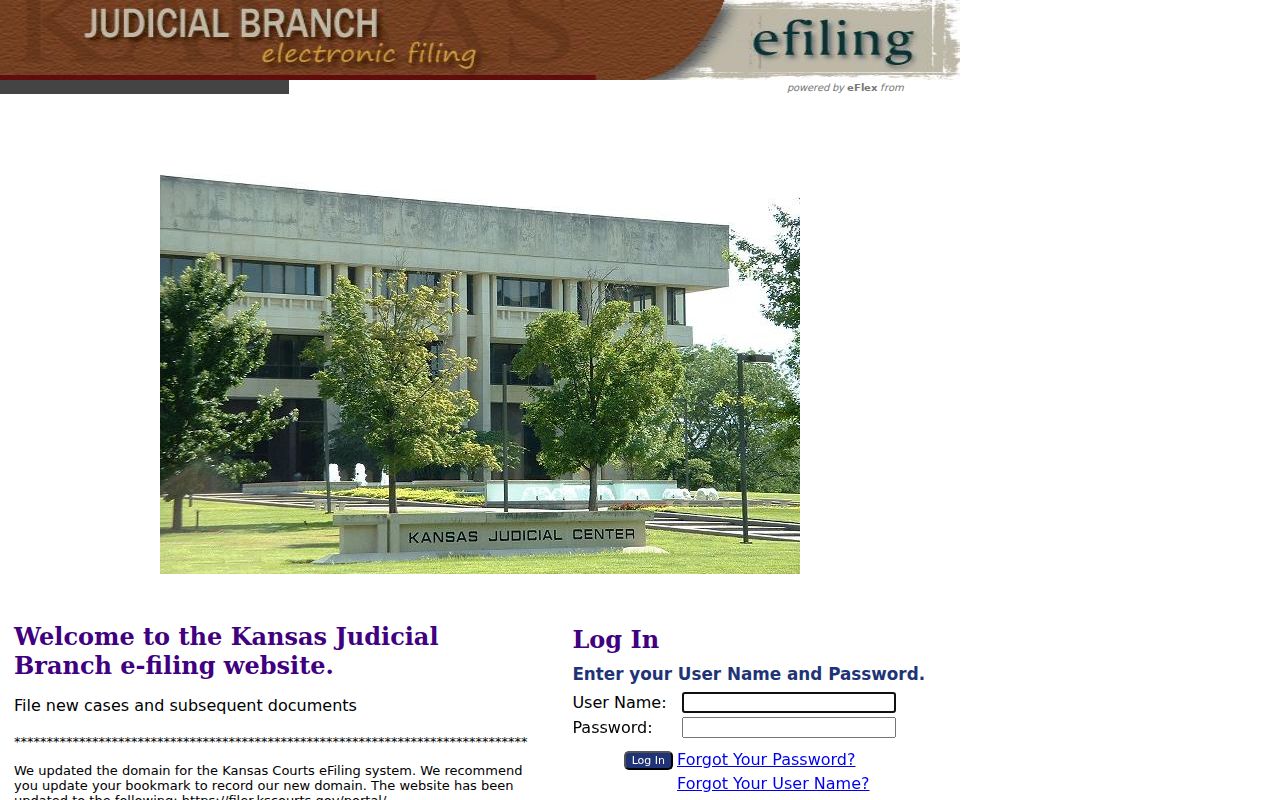
A submission that clears processing becomes part of the case record, still subject to clerk handling, redaction, and access rules. A filing receipt confirms the transaction itself. It does not guarantee that a public CaseSearch entry has appeared.
Kansas eFiling Is Not a Public Case Search
The names sound alike, but they are separate layers. Tybera eFlex is where an attorney or approved user submits a covered filing. Tyler Odyssey is the shared Kansas eCourt case-management environment. It holds the county file and its case events. Kansas CaseSearch is the public discovery interface for whatever the rules allow online. Three tools, three jobs.
Members of the public do not register in eFlex to browse court dockets. An eFlex account does not guarantee a document will show in the public portal either. The county clerk processes the filing. Rule 22 controls remote display. The Judiciary has published no service-level promise for overnight, instant, or real-time CaseSearch updates. When a public event is missing or time-sensitive, verify it with the clerk who holds the case.
Statewide Portal vs County Docket
Kansas CaseSearch can discover permitted case information statewide. It can also tell you which county holds a District Court file. The full case record is another matter. For archives, corrections, and certified copies, you need the county clerk. No separate county vendor search exists for current District Court cases; the county layer supplies local custody and service instructions behind the statewide index. Find your local office through the Kansas county directory.
The split matters when an online result looks thin or an older filing is absent. The statewide index can lead you to the file. It does not replace the clerk's official record. For an appellate case, ask the appellate clerk's office. Do not request the trial-court county to certify an appeal document.
| Task | Kansas CaseSearch | County clerk and case file |
|---|---|---|
| Find District Court case information | One public search across District Courts in all 105 counties. | County clerk answers case-specific questions for files held in that county. |
| See a public event | Displays events and details that may be shown online under Rule 22. | Clerk can explain the filed record and local access route. |
| Review a document | Some permitted documents may be available from the case record. | Request a public filed item that is not linked online. |
| Find an older file | Web documents follow local eCourt conversion dates and access rules. | Ask about courthouse-terminal, paper or microfilm holdings. |
| Obtain certification | Portal output is not automatically a certified copy. | Request authentication from the clerk holding the official file. |
Kansas eCourt Reached Every District Court by 2024
Kansas moved its District Courts onto shared case management in waves. The rollout began in 2019. Counties joined the eCourt environment in groups. Johnson County's 10th Judicial District went last, finishing in November 2024. After that, all 105 county District Courts ran on Kansas eCourt. That milestone closed the participation gap for current District case management.
It did not make every older paper record searchable online. Each county's go-live date matters. So do Rule 22 access limits and local archive holdings. They shape what public documents exist. Kansas CaseSearch now gives you a statewide starting point. County clerks remain the route for pre-conversion records, copies, and corrections. The 2024 Kansas Judicial Branch Annual Report records the rollout milestones.
Kansas Court Technology and History
Kansas's shift to shared case management took years to build. Annual-report timelines trace an eCourt and technology funding mechanism starting in 2014, the Tyler Odyssey selection in 2017, and implementation planning plus contract activity in 2018. District rollout began in 2019. Two distinct pieces came out of that change. Odyssey stores county case data, while Kansas CaseSearch exposes the information allowed through public access rules.
The web address changed too. The Kansas Judicial Branch moved its public domain to kscourts.gov in 2024, so older bookmarks or Smart Search guides may point to an earlier path or interface. The public appellate document portal has its own start boundary of March 13, 2025. Neither milestone means all prior paper filings were digitized. Use the current official portal for search, and ask the county clerk or appellate clerk about material outside its online range. The Kansas court domain-change notice spells out the switch.