
How to Search Kansas Criminal Dockets
Kansas CaseSearch covers District Court criminal cases in all 105 counties. Pick District, choose a search type, and add Criminal if you want. The form takes a case number. It also takes a party or business name, a party listed as a business, or a citation number. It publishes no strict name order, number mask, wildcard rule, minimum term, or date-span limit. So type the number exactly as the court printed it.
The portal may find the case yet hide papers. The county Clerk of the District Court holds the file itself, along with archived material and certified copies. A city ordinance charge stays with the Municipal Court named on the citation. The Kansas county directory lists each local clerk. One more caution: confirm any upcoming setting with the coordinator. An online event can lag a reset.
- Accept the portal terms, choose District, then select Case Number, Party Name, Business Name, Party As Business Name, or Citation Number.
- Enter the search term and select the county or court location shown for a District search. Use Criminal as an optional case-type filter.
- Complete the human check before searching. Open a result only when you are authorized to view it, and confirm its county and case category.
- Read the event chronology, then check the newest notice or call the local coordinator if the date is unclear.
- For the file, a courthouse terminal, or a certified copy, contact the county Clerk of the District Court through the county directory.
Kansas CaseSearch Criminal Filters
The live Kansas CaseSearch form splits court level, search type, and filters. District searches trial cases. Appellate covers the Kansas Supreme Court or Court of Appeals. Ten location choices divide five counties. Complete the human check to enable search; expanded access is role-limited and uses ID.me. The attorney e-filing system is not a public search.
The Judiciary warns that internet display is limited and not the official record. Its records page sends readers to courthouse terminals and the Clerk of the District Court for documents. A case can appear online while a public document sits terminal-only or restricted.
The Judiciary's District Court records explanation draws the line among internet access, courthouse terminals, and the county clerk. That statewide distinction is what should guide any criminal docket search.
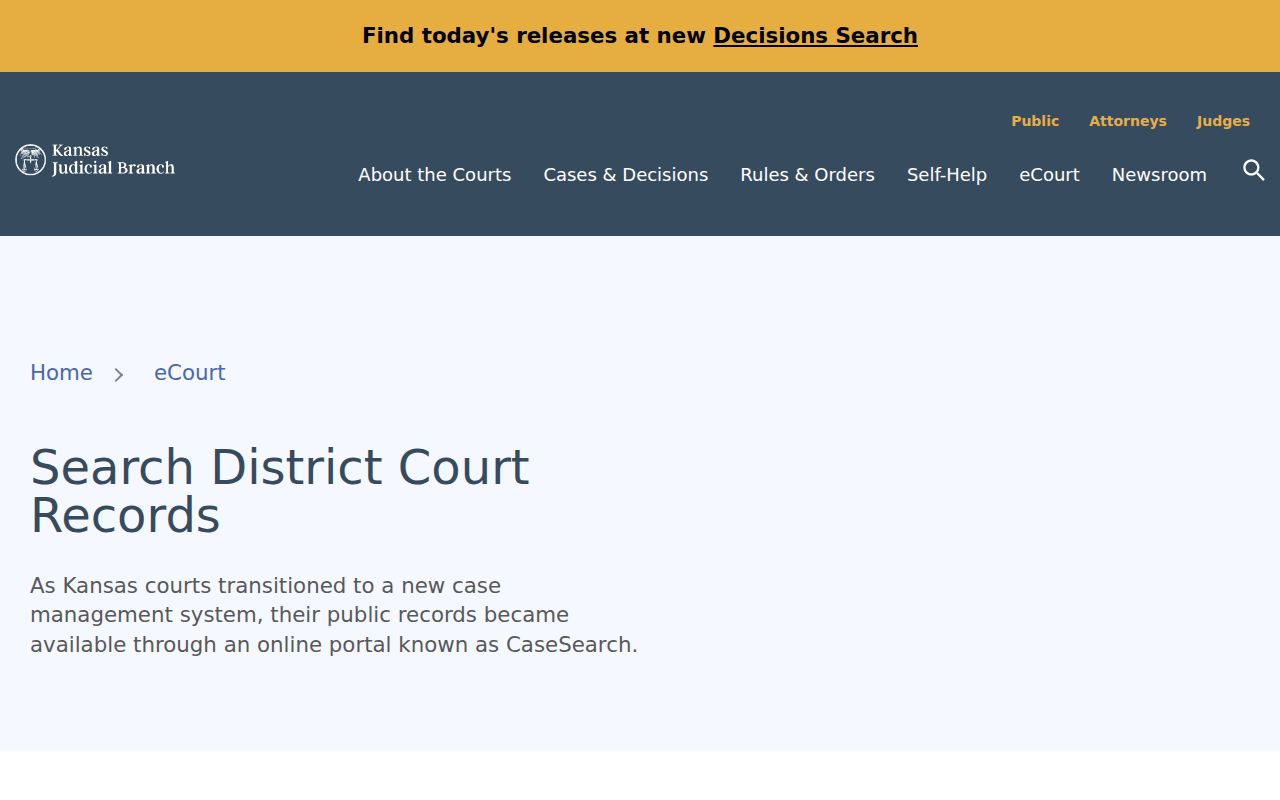
Locate the case in the portal first. Then go to the county clerk for the official case file and any copy that must be authenticated.
| Field Label | Type | Required | Notes |
|---|---|---|---|
| Terms of use | Consent buttons | Decision required | Accept or Decline before proceeding. |
| Court | Dropdown | Yes | Choose District for a trial criminal case. |
| Search Type | Dropdown | Yes | Case number, party, business, party as business, or citation. |
| County | Dropdown | District location | 105 counties, plus ten split-location choices. |
| Search Term | Text | Yes | No strict format or name-order hint appears on the initial form. |
| Additional Search Filters | Toggle | Optional | Expands district search filters. |
| Case Type | Dropdown | Optional | Criminal, Civil, Family, Probate, or Mental Health. |
| DOB | Date input | Optional | No format example or reason/access notice appears in the filter panel. |
| File Date From / To | Date inputs | Optional | No maximum date span or default date is shown. |
| Human check | Challenge | Needed to search | Completing the challenge enables the search action. |
| Reset | Button | Optional | Clears the initial form. |
| Log in / Register | Account actions | Optional for basic view | Expanded access is role-limited and ID.me-controlled. |
DOB is optional; enter it only when permitted and there is a legitimate reason.
What a Criminal Docket Shows
Kansas Supreme Court Rule 21 defines an events index, also called a register of actions. It is a chronology of filings and court events. It is not the case record. A criminal docket can name a charge, hearing, or order. It leaves the charging paper, signed judgment, or transcript unseen.
Official descriptions list basic case-information categories. They promise no universal display of charge detail, bond, plea, balance, disposition code, or documents. Kansas publishes no statewide public criminal-code list. When a field is missing, ask the clerk for the controlling text.
| Case number and type | The court identifier and broad category; older Kansas guide examples use a county prefix, year, case type, and sequence, such as RL-2019-CR-000001. Formats and conversion dates vary, so do not recode a number. |
|---|---|
| Participants and counsel | Public record descriptions identify case participants and attorneys; party roles or attorney details may differ by case. |
| Assigned judge | A case-information category identified in official records guidance; verify the current assignment with the court. |
| Hearing dates and events | Public information may include hearing dates. Read later events for a reset or amended notice. |
| Charge and result | Do not assume charge degree, plea, sentence, or disposition code is universally shown. Obtain the filed document or ask the clerk. |
Note: The old Smart Search number example documents a prior portal format. It is not a required mask for the current Kansas CaseSearch screen.
Kansas Criminal Motions and Orders
A filed motion asks the judge for something. Its entry does not show the judge granted it. A hearing may follow, and the ruling can surface in a later order or journal entry. In a Kansas criminal docket, follow the event sequence to the signed result before calling a motion decided. Bond deserves the same care: an old bond entry does not prove current release status, since conditions may live in another order or change later.
These terms describe steps, not fixed CaseSearch codes. The courts publish no official statewide abbreviation list. Ask the county clerk about a file term, or the coordinator about a live schedule; the signed order states the court's direction.
- Arraignment
- A proceeding where the charge is addressed and a plea is taken or scheduled.
- Motion
- A written request for a ruling; filing alone does not mean it was granted.
- Continuance
- A delay or change to a scheduled hearing or trial date.
- Disposition
- An outcome or status recorded when a case or charge is resolved.
- Expungement
- A legal process that limits public access after the required court order and statutory conditions.
Stages on a Criminal Docket
Kansas felonies and misdemeanors are heard in District Court. A case may open with a complaint, information, or indictment, then record an appearance, bond review, preliminary hearing, conference, motion, or trial setting. The charge, custody status, waiver, and rulings shape its path.
Criminal case flow: Charges Filed › Arraignment › Pretrial › Plea or Trial › Disposition › Sentencing
A motion is not a ruling, and a setting does not prove a hearing occurred. Later events can bring sentencing, post-judgment review, or a separate appeal in the Kansas Court of Appeals or Kansas Supreme Court.
Note: Read from the oldest event to the newest. Then obtain the signed judgment when the exact result matters.
Kansas Criminal Diversion Is Case-Specific
Diversion can resolve a criminal matter without an ordinary conviction if its conditions are met. Availability and result turn on the charge, case posture, prosecutor, and applicable law. A docket label does not mean the case is closed. Check for a later dismissal order or journal entry. Kansas does not use “deferred adjudication” as a universal outcome, and diversion differs from expungement, which limits public access only when legal and statutory conditions are met.
When a Kansas Criminal Search Shows Nothing
A blank result in Kansas CaseSearch is not proof that no file exists. Before giving up, check four things: the court level, the county, the case number, and the type of search you ran. A city ordinance matter sits in Municipal Court, not District Court. Federal charges live with the U.S. District Court for the District of Kansas instead. Older files can hide an item from internet search. So can restricted cases and Rule 22 limits.
If the online docket still comes up empty, try a courthouse terminal. Then ask the county Clerk of the District Court whether the file is archived or restricted. A Kansas Open Records Act request cannot break a seal or a confidentiality rule. Got a city ticket? Call the Municipal Court clerk named on the citation.
Kansas Supreme Court Rule 22 draws the line. It separates what the public internet shows from what only a courthouse terminal reveals.
Which Court Holds Criminal Dockets
Kansas skips the county Justice of the Peace model found elsewhere. One general trial court, the District Court, handles the state's criminal dockets. District Magistrate Judges sit within that court rather than forming a separate tier. Each county also has a Clerk of the District Court under K.S.A. 20-343.
City ordinance charges run through Municipal Court and its own clerk. They sit outside the statewide portal's District/Appellate selector. A municipal appeal moves up to District Court. Federal cases go through the federal clerk and PACER. For the local layer, start with the county directory. You can also follow the city court named on the citation.
| Charge or stage | Likely court file | Where to confirm |
|---|---|---|
| State felony or misdemeanor | County District Court criminal case | Kansas CaseSearch, then county District Court Clerk |
| City ordinance charge | City Municipal Court | Court and clerk named on the citation |
| Appeal from a trial matter | Separate Kansas appellate case | Appellate CaseSearch and appellate clerk resources |
| Federal charge | U.S. District Court for the District of Kansas | Federal clerk and PACER |
Confirming an Old Kansas Criminal Setting
An old setting on a Kansas criminal docket is easy to misread. Later events tell the real story. Read them before assuming a hearing was held or a case was dismissed. A continuance, a reset, an amended notice, a plea, or a disposition can change what that date meant. The state publishes no uniform reset-code list.
For the current date, call the Trial Court Coordinator. For the register or copies, call the clerk. Ask directly whether the event was held, vacated, continued, or reset. Then follow the most recent notice for appearance details.
Note: A Kansas CaseSearch file-date filter narrows by filing date. It does not list every case scheduled for a chosen hearing date.
Public Access and Sealed Criminal Dockets
Public electronic access to Kansas court records runs through Kansas Supreme Court Rule 22. Adoption, Child in Need of Care, grand jury, expunged, and specified protection cases stay out of public internet search. Other categories may show case information while blocking the documents themselves. Juvenile-offender records can remain limited even when a case is searchable.
The Kansas Open Records Act (KORA), K.S.A. 45-215 et seq., governs public agency records. But court-file access also answers to judicial rules and confidentiality laws. Send case-file questions to the county Clerk of the District Court, the Municipal Court Clerk, or the appellate clerk, whichever applies. A KORA response does not promise disclosure. For Judicial Branch administrative records, the request form accepts email, mail, pickup, or fax. Use the court clerk's process for case files.
Kansas access rules:
Kansas Supreme Court Rule 22 sets internet and courthouse-terminal access and lists limits by case type and document.
K.S.A. 45-218 requires a KORA response by the end of the third business day, but that response is not a guaranteed fulfillment deadline.
K.S.A. 45-219 ties public-record charges to actual costs, which can vary with retrieval, staff time, copying, and delivery.
K.S.A. 45-221 lists exceptions and allows public material to be separated from protected portions where applicable.