
Traffic Court Records in Kansas
Two court systems hold Kansas traffic records. State-law citations under the Uniform Act Regulating Traffic on Highways land in the District Court of the county where the alleged offense occurred. The county Clerk of the District Court keeps that case file. City-ordinance tickets go to the Municipal Court and clerk named on the citation. Kansas has no county Justice of the Peace tier. A state ticket never routes to an unlisted JP court.
Note that some state-law traffic charges are misdemeanors rather than simple administrative fines. Read the citation and its court instructions carefully. The court record and the driver's status record sit in separate hands. Confirm any setting with the issuing court directly.
For a county-level illustration, the 18th Judicial District Traffic Department shows how one District Court traffic division handles state and highway citations.
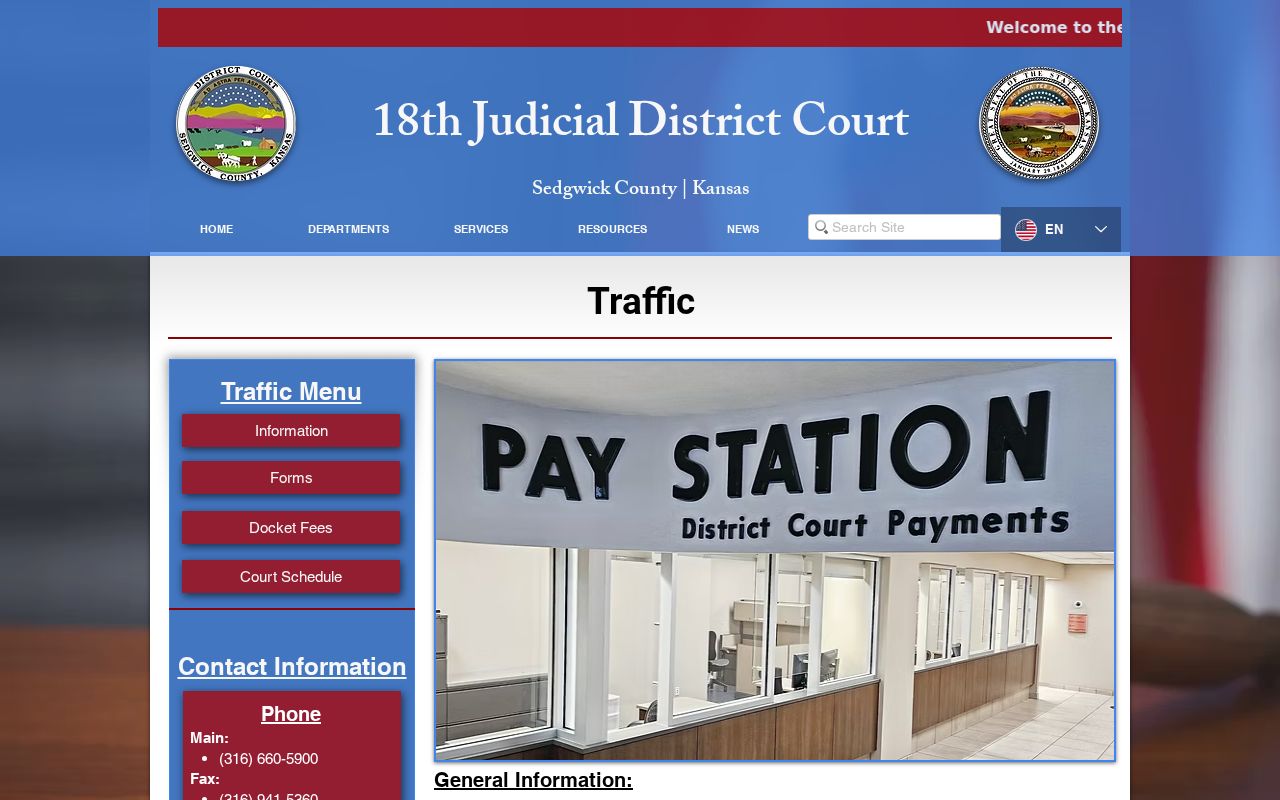
That local page is just one county's example, not a statewide traffic database or a universal clerk contact.
Kansas Traffic Tickets Go to District Court
Under K.S.A. 8-2106, a state-law citation goes to a District Court judge. The judge sits in the county where the alleged offense occurred. The ticket lists the court, the time, the place, and the charge. Unless the driver demands an earlier hearing, the appearance time must fall at least five days after the violation. Trust the date and court printed on the citation. Then confirm any change with the issuing clerk or coordinator.
City ordinance tickets stay with their named Municipal Court. That court sits outside the District/Appellate selector in Kansas CaseSearch. A payment processor is not a citation-search service.
Statewide Citation and License-Hold Systems
Kansas runs two useful tools: a District Court case search and a state driver-status check. What it lacks is one statewide Municipal Court citation search or a public license-hold lookup. Each system below serves a different purpose and answers to a different office.
| System | What It Holds | Run By |
|---|---|---|
| Kansas CaseSearch, District / Citation Number | District Court cases, including state traffic citations entered in eCourt | Kansas Judicial Branch and county District Courts |
| Municipal Court site or counter | That city's ordinance and traffic docket and local payment steps | Individual municipality |
| K.S.A. 8-2110 compliance process | Court noncompliance notice and electronic status notice after statutory steps | Issuing District or Municipal Court; Division of Vehicles receives notices |
| Driver License Status Check | A license holder's Kansas driving privilege/status summary | Kansas Department of Revenue, Division of Vehicles |
| Participating-case payment endpoint | Online payments for participating cases; not a case search | State-linked payment processor |
| Courthouse terminal and clerk | Public District Court file, copies, and older records | County District Court |
The Kansas Courts eFiling System runs on Tybera eFlex software, and every filing moves into Kansas eCourt, which is built on Tyler Odyssey. This platform exists for attorneys and other authorized users. It is not a public docket search. Its payment endpoint handles only participating cases, so when in doubt, follow the instructions on the ticket itself.
Kansas Municipal Courts Hold City Traffic Tickets
Kansas CaseSearch lets you search by Citation Number for District Court cases only. A city traffic ticket works differently. Check the court line printed on the citation or the court's own page. When a ticket lists no contact details, the county directory can connect you with local court information and point you to the right Municipal Court.
Each city court builds its own lookup, payment, and contest procedures, and Kansas posts no statewide municipal database or shared field list. A terminal at a county District Court cannot search a city's ordinance docket either.
How to Look Up a Kansas Traffic Ticket
Start by identifying the court that issued the ticket. Kansas CaseSearch may turn up a District Court case, but Rule 22 keeps citation images filed under K.S.A. 8-2106 off the public portal. A city ticket stays with the Municipal Court named on the citation.
- Read the citation to identify a state-law District Court case or a city-ordinance Municipal Court case.
- For District Court, open Kansas CaseSearch, choose District, then select Citation Number and enter the citation number.
- Select the county or split court location shown for a District search. The search also requires a human-check challenge.
- For a city ticket, use the Municipal Court named on the citation or the city's official court page; CaseSearch has no Municipal Court selector.
- If the result is missing, check the number and county, then ask the county Clerk of the District Court about the public terminal or archived file.
- Use the Kansas county directory to find the local court layer. For an upcoming setting, confirm the newest date with the court coordinator.
- Follow the citation's own payment, appearance, and contest instructions. A payment endpoint is not proof of a current hearing date.
| Field Label | Type | Required | Notes |
|---|---|---|---|
| Terms of use | Consent buttons | Decision required | Accept or Decline before proceeding. |
| Court | Dropdown | Yes | Choose District for a state-law trial ticket. |
| Search Type | Dropdown | Yes | Includes Citation Number, Case Number, Party Name, and business options. |
| County / location | Dropdown | District search | 105 counties and ten split-location choices. |
| Search Term | Text | Yes | Enter citation number if known; no number mask is published on the form. |
| Additional Search Filters | Toggle | Optional | Expands optional fields for District searches. |
| Case Type | Dropdown | Optional | Criminal, Civil, Family, Probate, or Mental Health; traffic coding may vary. |
| DOB | Date input | Optional | Not required for citation-number search. |
| File Date From / To | Date inputs | Optional | File dates are not citation dates or hearing dates. |
| Human check | Challenge / button | Needed to search | The search action is disabled until verification. |
| Reset | Button | Optional | Clears the form. |
Date of birth is optional on a Kansas ticket lookup. Enter it only where the court permits it, and only for a sound reason. If a hearing is coming up, the Kansas court calendar instructions walk you to the county setting so you can confirm a reset before you rely on the old date.
Kansas Traffic Ticket Failure-to-Comply Notices
Miss a court date or skip a fine that a Kansas court ordered, and K.S.A. 8-2110 calls it failure to comply. The statute counts failing to appear. It also counts failing to pay court-ordered fines or costs, or breaking K.S.A. 8-2118 in any other way. It stays a misdemeanor no matter how the original traffic charge ends.
The court mails a notice first. For covered violations, you get 30 days from the mailing date. After that, the court sends electronic word to the Division of Vehicles, though listed exceptions apply. Once the referral happens, the statute sets a $100 reinstatement fee. It also allows a hardship petition to shrink or waive set amounts. A court may also charge up to $5 just for mailing the notice. These figures sit apart from the ticket fine and costs. Confirm your current balance with the issuing court.
After you substantially comply, the court notifies the Division of Vehicles electronically. The restriction lifts once the Division receives that notice. Keep in mind that the court docket and your license status stay separate records. Kansas offers no statewide public hold check.
Paying or Contesting a Ticket in Kansas
Your citation carries the response date that controls everything. For a traffic infraction, K.S.A. 8-2118 and K.S.A. 8-2106 lay out the choices: a written appearance, a trial waiver, a guilty or no-contest plea, or payment of the scheduled fine and costs. Want to fight it? Follow the response or appearance process printed on the citation.
| Path | What It Means | Docket / next step |
|---|---|---|
| Pay an eligible infraction | The statutory path includes a guilty or no-contest plea and trial waiver, plus the scheduled fine and court costs. | Follow the citation and issuing court's instructions before the appearance date. |
| Contest the citation | Use the court's process to dispute the charge; a hearing or trial setting may follow. | Check the court notice and confirm any date with the local coordinator. |
| City ordinance matter | Follow the named Municipal Court's local procedure. | A city payment site and its docket may be separate; CaseSearch is not the city interface. |
Missed date or unpaid court balance: Kansas law treats failure to comply as a separate misdemeanor and allows court notice and a Division of Vehicles referral after the required steps. Contact the court that issued the ticket to resolve the court matter, then check license status with the Division separately. Fines, costs, and any reinstatement fee are distinct amounts.
No Kansas law guarantees dismissal for taking a defensive-driving course. Diversion hinges on the case and the prosecutor. Commercial driver license holders face tighter limits under K.S.A. 8-2,150.
A Paid Kansas Traffic Infraction Waives Trial
Paying a Kansas infraction can mean a guilty or no-contest plea plus a waiver of trial. The citation controls. Read its options, and ask the issuing clerk if the legal effect or the amount is unclear. City ordinance payments follow local Municipal Court procedures.
Kansas Traffic Searches Can Return Nothing
A Kansas CaseSearch query can come back empty. First figure out which court holds the ticket. Was it filed under state law or a city ordinance? For a District Court case, double-check the case number and county. Remember that the District/Appellate selector never covers city dockets. A city ticket belongs to the Municipal Court printed on it. Call that court directly.
The county Clerk of the District Court can help with a missing entry, older archives, a public terminal, or copies. The Trial Court Coordinator can confirm a live court date. The county directory lists local contacts. For Judicial Branch administrative records, KORA requests under K.S.A. 45-215 et seq. can go by email, mail, pickup, or fax on the standard form. If a failure-to-comply notice triggered the search, resolve it with the issuing court first. Then verify license standing with the Division of Vehicles.
A missing online citation document may simply mean Rule 22's document limit was reached. It does not mean no court file or case event exists. For the details, read Kansas Supreme Court Rule 22 on electronic document access and K.S.A. 8-2106 on citation and appearance procedure.
Court Traffic Record vs Driver Record
A Kansas traffic case and a driver record are two different files. The court docket holds the citation, each event, the plea, the disposition, and any orders. License status lives elsewhere, with the Kansas Department of Revenue, Division of Vehicles. Courts send outcomes to the Division. Still, the status tool is no substitute for a certified disposition from the court.
Use the Kansas Driver License Status Check only for your own license. It is not a public case lookup for someone else. The form wants a license number, name, and date of birth. It returns only a limited summary.
| Question | Court traffic record | Driver status record |
|---|---|---|
| Custodian | District Court Clerk for a state-law citation; Municipal Court Clerk for a city ticket. | Kansas Department of Revenue, Division of Vehicles. |
| Search route | Kansas CaseSearch for District Court; the named city court for an ordinance case. | Driver License Status Check for the license holder. |
| Typical information | Citation, filed events, appearance, plea or disposition, and court order, subject to access rules. | Driving privilege and driver-record information; the status result is a summary. |
| Does not establish | Every current licensing status or every city's ticket. | The court's full case history or a certified disposition. |
The KDOR status form is a separate agency interface, not a traffic-case lookup.
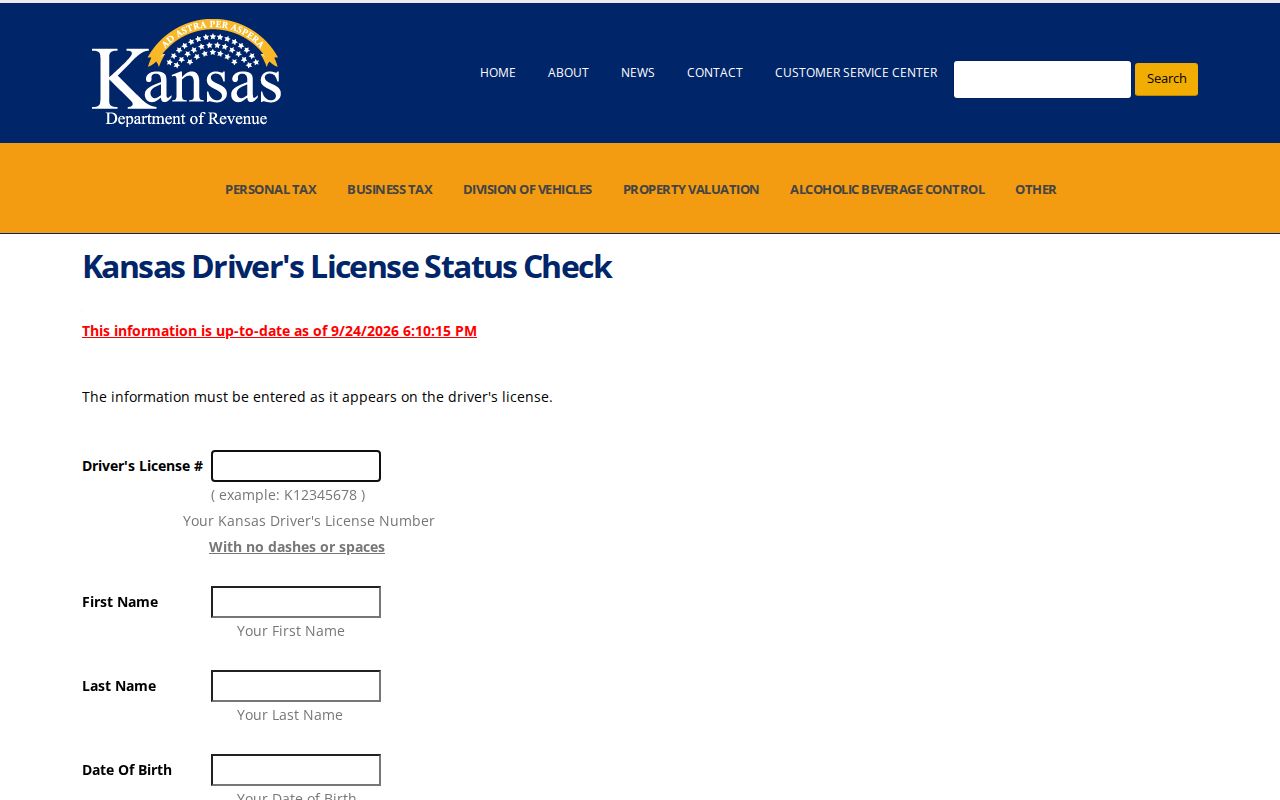
For the Kansas court record itself, go back to the issuing court. The Division of Vehicles answers only the holder's license-status question.